

While Russia’s invasion shocked many across the world, for Ukraine, the invasion marked a continuation of its centuries long struggle to preserve and defend its identity and sovereignty.
By Noah Ashe
February 24, 2023

1 Year of War – A Recap:
KYIV, UKRAINE – Today marks one year since Russia began its full-scale invasion of Ukraine. The invasion came after months of the Russia massing forces along its border with Ukraine and in neighboring, Belarus. While there was much speculation as to if and when war would even breakout, it still came as a shock to many in Ukraine and around the world. The invasion marked the most significant escalation in the broader nine-year long Russo-Ukrainian War that until February 2022 had mostly settled into a frozen conflict, similar to those in other post-Soviet states. Russian President Vladimir Putin claimed in a nationally televised address that the goal of the “special military option” would be to “demilitarize” and “denazify” Ukraine — a particularly offensive claim that fails to acknowledge both Ukraine’s President and Prime Minister are Jewish and lost family members during the Holocaust.

To the surprise of many, the Ukrainian Army has been able to defend and reclaim territory despite being outgunned and outmanned by its much larger neighbor. Since the invasion began, the United States, NATO, and European Union (EU) have been supplying and aiding the Ukrainians with an ever increasing amount of weapons, humanitarian aid, intelligence, and support on the international stage whilst reaffirming there will be no direct war with Russia. Both Russia and Belarus have been subject to a growing amount of crippling economic sanctions that have resulted in an exodus of Western companies leaving the Russian and Belarusian markets altogether, with younger Russians emigrating abroad to escape the ever growing repression back at home leaving Russia and its economy more isolated than it has ever been previously. While Russia spent the eight years preceding the invasion preparing for this scenario and in response implemented measures designed to mitigate the worst impact of the sanctions, economists have cautioned that the full impact of these sanctions will become clearer over time rather than immediately.
Attempts to quickly occupy the entire country and seize the capital of Kyiv to depose the government of President Volodymyr Zelensky backfired with the depleted Russian convoy that was to lead the assault on the capital repositioning to the east and south of the country after facing steep battlefield losses and stiff resistance from its Ukrainian defenders. Because of this, the initial goals of the Kremlin have shifted becoming markedly smaller in its aims. When Ukrainian troops recaptured the Kyiv suburbs that had been occupied by Russia from the onset of the war, they were met with scenes of utter horror and devastation.
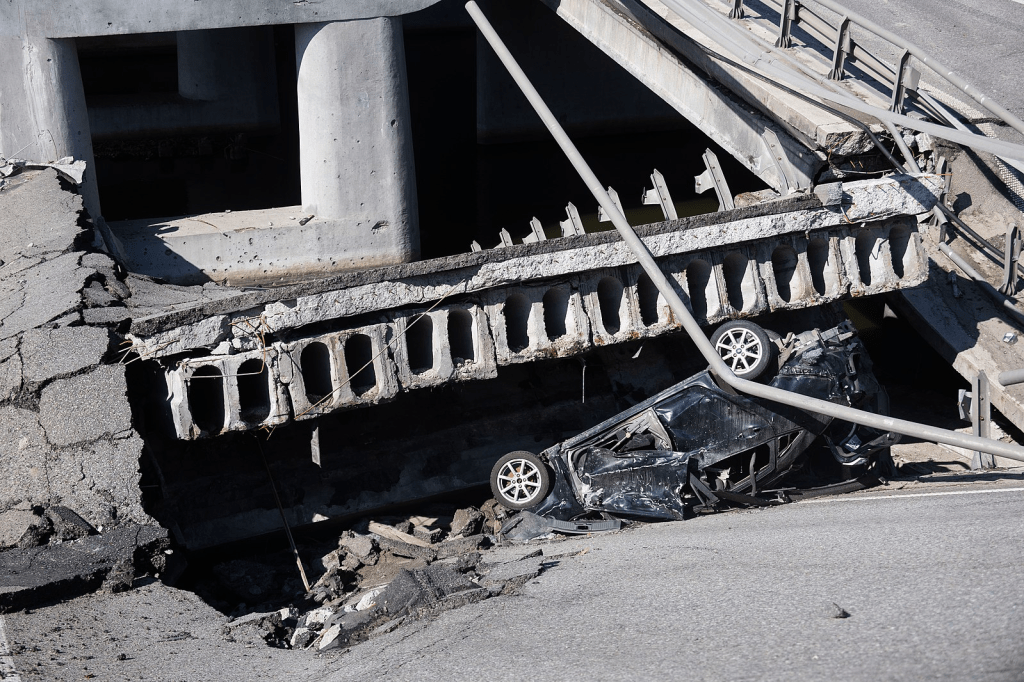

In Bucha, Ukrainian soldiers, civilians, and members of the international press were confronted with grisly scenes of men, women, and children lying scattered across the city with overwhelming evidence suggesting that the occupying Russian forces indiscriminately targeted Ukrainian civilians in alleged crimes against humanity involving torture, sexual violence, and murder with many of the bodies found in the streets or in mass graves. A number of those found appeared to have been shot at close range, some in the back of the head and others with bags over their heads and hands tied behind their backs. The images quickly ricocheted across the world and galvanized further support for Ukraine. Since these initial discoveries last April, these scenes of violence have been rediscovered across the country.

Ukraine has demonstrated the capability to conduct strikes against Russian military assets such as the sinking of its Black Sea Fleet flagship, the Moskva, as well as conducting strikes deep inside Russia proper, including that of the occupied Crimean peninsula. Despite the string of Ukrainian successes, many analysts expect the war to continue in the coming months and possibly years ahead, with Vladimir Putin showing no signs of backing down. In late September, Putin significantly escalated the war, announcing a “partial mobilization” of 300,000 men to join the frontlines and formally announced the annexation of four Ukrainian oblasts or provinces into Russia proper.
After losing ground in the Donbas in the summer, in early September, Ukraine launched a surprising counteroffensive, reclaiming more than 6,000 kilometers of formerly occupied territory in the east and south. These efforts culminated on November 11 with the liberation of Kherson, the only regional capital Russian troops had seized during the course of the war, providing a valuable morale boost to the Ukrainians while additionally underscoring the systemic shortcomings of the Russian military. While this momentum has now slowed, both sides have signaled they will renew major offensive operations in the near future as spring nears.
While it is impossible to predict the outcome of this war, it has become increasingly clear that the war has not gone well for Russia. After almost a year of refusing to supply the Ukrainians with tanks and armored vehicles that would be needed to launch a larger counteroffensive, the United States and its allies recently announced they will begin to send Ukraine some of their most advanced tanks to further assist the Ukrainians in retaking more occupied territory though still refusing to send fighter jets at the time of this writing. Ukrainians across all walks of life have vowed to continue the fight until Ukraine emerges victorious while promising to never forgive Moscow. This however, has come at a massive cost for Ukraine, with mounting civilian casualties and Moscow recently resorting to striking civilian infrastructure and other civilian targets in an effort to break morale amid the cold winter.
Ukraine’s Long Road to Independence:
In many ways, Ukraine has struggled to assert its identity and independence since the dissolution of the Soviet Union in the closing days of 1991. The foundations of what would become the modern Ukrainian state dates back to the mid-11th century with the establishment of the Kievan Rus. The founding of the Rus and the settling of what would become the capital Kyiv predates that of Moscow and Russia itself.
After spending years under the domination of the Russian Empire, in the immediate aftermath of the First World War, Ukraine experienced a brief period of independence, seeing an opportunity to break away from the crumbling Empire before Bolshevik forces invaded and destroyed the fledging republic. For nearly seven decades after, Ukraine was a constituent republic of the Soviet Union (USSR) and considered one of the most strategically valuable republics due to its location on the Black Sea and its optimal conditions for agriculture. Not unlike other parts of the former USSR, Ukraine had a lengthy history of drawing a line of distinction between itself and Russia. For this, it suffered greatly. Starting in the 1930s, the Holodomer, a famine that is believed to have been deliberately started by Soviet leader Joseph Stalin ravaged the country, killing 4 million Ukrainians in part to thwart any further ambitions of greater autonomy.
In June 1941, in the midst of the Second World War, Nazi Germany and its allies launched an invasion of the Soviet Union and much of Ukraine was occupied during this time. Prior to WWII, Ukraine had one of Europe’s largest Jewish populations, numbering at an estimated 2.45 million. By the time the Soviets had turned the tide of the war, nearly 1.5 million of Ukraine’s Jews would be dead. By some estimates, using modern day borders, nearly one in every four Jewish victims of the Holocaust died in Ukraine, decimating the Ukrainian Jewish community. According to PBS, while a sect of Ukrainians welcomed and collaborated with the Nazi occupation as a way to challenge Soviet domination over the country, Ukrainians played a pivotal role in repelling further German military advances and in reversing the tide of the war in favor of the Soviets and the Allies.
Ukraine emerged from the WWII as an industrial and agricultural hub. While under Stalin, any expression of Ukrainian identity was violently repressed, under his successor, Nikita Khrushchev, the repression of the Stalin era was softened though this was followed by another push to ‘Russify’ the republic in part by curtailing the usage of the Ukrainian language in favor of forcing the Russian language on the local population. In subsequent decades, Ukraine saw additional periods of Russification and further suppressions of Ukrainian culture.

However by the 1980s, Ukraine had begun to stagnate, both culturally and financially. These issues came into focus in April 1986 with the nuclear accident at Chernobyl. In its wake, dozens died from radiation poisoning while an estimated 5 million were exposed to elevated levels of radiation, causing numerous health issues later on. Rather than immediately admitting the full scale of the disaster, Soviet leaders decided to attempt to hide the incident from the rest of the world though this did not last for long. For Ukrainians, the Chernobyl accident was to mark the beginning of the end of Soviet rule in Ukraine and the collapse of the USSR itself.
The rise of Mikhail Gorbachev in the mid-1980s coincided with the introduction of glasnost (“openess”) and perestroika (“restructuring”). Ukraine found itself increasingly grappling with a surge of nationalism and a renewed sense of Ukrainian identity. Issues surrounding the environment, the economy, language and culture began to be openly discussed among its citizens.
By 1989, the Soviet Union indicated that it would no longer intervene militarily in the Eastern Bloc to continue to prop up the communist governments from growing public discontent. As a result, the Bloc disintegrated within a year, with the mostly peaceful overthrow of the former communist governments and a rapid transition to Western styled capitalism.

A year later by 1990, with its former backyard firmly in the West’s camp, many in the USSR began to ask if the self-determination that was allowed in the Eastern Bloc was applicable to the USSR’s own republics. Starting with Lithuania in 1990 and later joined by its Baltic neighbors and Georgia, in quick succession the USSR began to unravel.
After a failed coup attempt against Gorbachev in August 1991 by hardliners failed, the closing days of the USSR were marked by Moscow losing most of its authority over its former territory. That same month, Ukraine’s parliament declared independence from Moscow, a declaration later reaffirmed by a referendum on December 1. Finally on December 26, 1991, after nearly 70 years, the Soviet Union was dissolved with a whimper. The Cold War was declared over.
Among the major issues confronting newly-independent Ukraine was the status of the several thousand nuclear warheads still stationed on its territory. At the time of the USSR’s dissolution, Ukraine effectively held the world’s third largest nuclear stockpile. While anti-nuclear sentiment ran high among the population, some of Ukraine’s leaders questioned the benefits of blindly dismantling its stockpile in light of a potential nuclear adversary on its border, causing alarm in the West and the Kremlin. In 1994 after substantial international pressure, Ukraine, Russia, the United Kingdom, and the United States signed the Budapest Memorandum, an agreement that guaranteed Ukraine would declare itself to be a nuclear-free state and hand over control of its nuclear stockpile to Russia. In return, the three powers agreed to respect and recognize Ukraine’s borders and sovereignty.
Over the next decade, the relationship between Russia and Ukraine was relatively stable despite an undercurrent of tensions over the status of Crimea, the future of Russia’s Black Sea Fleet and Ukraine’s growing alignment with the West. Starting in late 2003 wider cracks began to emerge in the relationship.
The Orange and Maidan Revolutions:
The 2004 Ukrainian presidential election between pro-European candidate, Viktor Yushchenko and pro-Kremlin candidate, Viktor Yanukovych was an incredibly close race with the election going into several rounds before massive protests demanding a formal recount erupted across the country. Yushchenko eventually emerged victorious but not before being mysteriously poisoned by dioxin leaving his face permanently disfigured. Under Yushchenko, Ukraine continued to push for closer ties to the EU and NATO, which in doing so infuriated the Kremlin believing that Ukraine firmly belonged in Russia’s sphere of influence.
Tensions rose in 2008 at the annual NATO summit where the question of Ukrainian and Georgian membership in NATO was openly discussed for the first time. While Ukraine wasn’t offered a formal path to membership, it was received a vague assurance that it would be offered NATO membership at some point in the future. Georgia was later invaded by Russia that same year, in part to pressure the Georgian government to remain out of NATO.
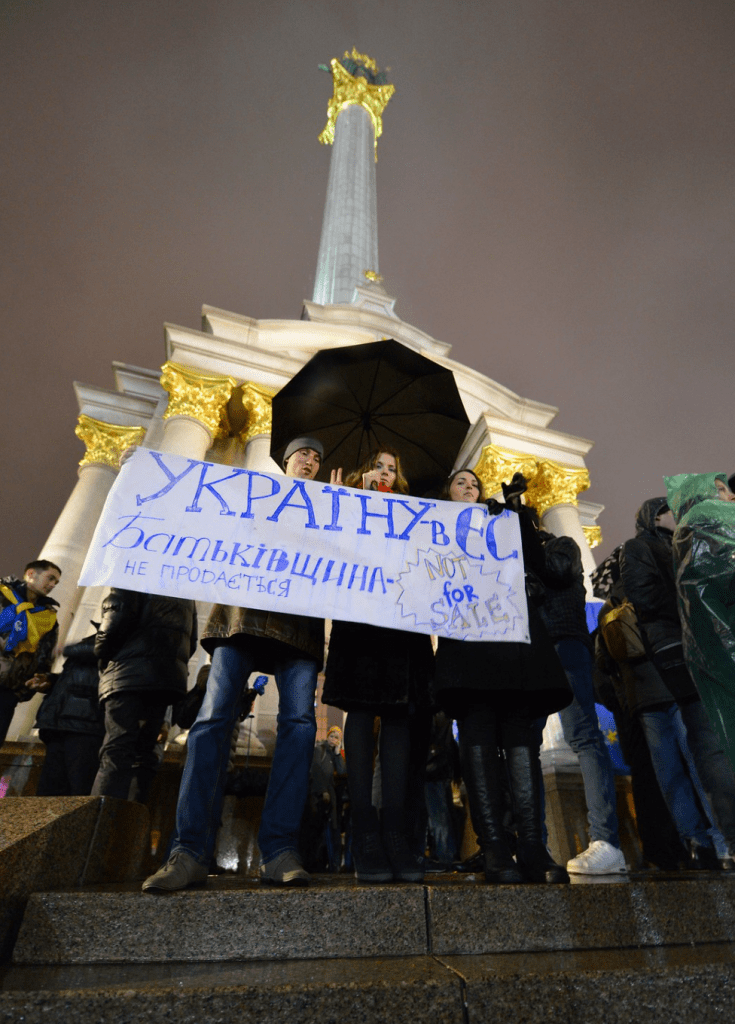
Only two years later in 2010, Yanukovych was elected president, firmly putting the country back in Russia’s orbit. This was not to last. In late 2013, after promising to sign an association agreement with the EU to deepen cooperation followed by a last minute trip to Moscow, Yanukovych reneged on signing the agreement in favor of deepening economic ties with Russia. Protests soon began in earnest to demand Yanukovych’s government to sign the EU agreement. After police cracked down violently, what started as largely peaceful protests quickly devolved into a revolution that saw the deaths of 100, the ousting of Yanukovych as president and his exile to Russia.
In Moscow, the reaction was swift. After coming to power in late 1999, Vladimir Putin had pursued a more forceful and confrontational foreign policy, in part seeking to reestablish its dominance over the former USSR. The Kremlin remained deeply concerned about NATO’s post-Cold War expansion into the former Eastern bloc, deeming it to be an existential threat to Russia’s security interests.
In March 2014, Putin mobilized his army to occupy and annex the Crimean Peninsula and soon provoked an armed separatist conflict among the mostly Russian speakers living in the Donbas. While largely static in the few years preceding the invasion, by early 2022, the conflict had killed an estimated 14,000.
The elections of Petro Poroshenko in 2014 and Volodymyr Zelensky in 2019 were seen by the Kremlin with anxiety. Zelensky, a former comedian was seen by many as political novice though he campaigned on an anti-corruption and poverty drive, and promised to end the conflict in Ukraine’s east. Since his election, Zelensky has continued to deepen ties with the West and crack down on Kremlin backed oligarchs at home. In response, Russia began to more loudly and openly question Ukraine’s right to exist as a sovereign country and escalated the conflict in the Donbas.
The Road to War Escalates:
After several ceasefires and peace proposals failed to resolve the conflict in the east, in April 2021, Russia began its first buildup of military forces along its border with Ukraine raising the stakes. This was followed by a larger second buildup of forces starting in December 2021 and January 2022 with Russia sending more troops and assets to the border — eventually surrounding Ukraine on three sides — in Belarus to the north, the separatist controlled territory in the east, and Crimea to the south. Eventually Putin’s government presented Ukraine and the West with a series of demands that were immediately rejected as non-starter by Kyiv and its allies:
- A formal guarantee Ukraine would never be allowed to join NATO;
- NATO would move of all its forces and assets out of Eastern Europe to its pre-1997 borders.
- NATO would not be allowed to continue expanding east.
- NATO would be banned from conducting military drills in Ukraine, Eastern Europe, Central Asia and the Caucasus states without prior permission from Moscow.
By early February 2022, the conflict in the Donbas began to escalate as shelling and exchanges between Ukrainian forces and separatists increased. Days before the invasion, Moscow formally announced it had recognized the sovereignty and independence of the self-proclaimed Donetsk and Luhansk Peoples’ Republics and at their request, sent the first Russian forces across the border. While American and British intelligence had long sounded the alarm that Moscow was planning a full scale invasion, in Kyiv the mood remained optimistic with many in the Ukrainian government, including President Zelensky himself believing that the full-scale invasion the West had been predicting would fail to materialize.
Static Frontlines and the Future:
Problems for the Russians began almost immediately after its forces crossed the border into Ukraine. While the invasion still came as an ugly shock and Ukraine’s government was viewed as woefully unprepared, the military had been making crucial preparations in the weeks and months before February 24. Most notably, Ukraine’s much smaller air force remained and still remains operational at the time of this writing due to equipment being moved off bases, denying Russia air superiority.
Additionally, Russia failed to recognize that the Ukrainian military it faced in 2022 was a far cry from its 2014 past, with Ukrainian forces gaining crucial battlefield experience from years of fighting Moscow’s proxies in the east. Furthermore, new evidence shows how ill-prepared the Russians were, with some only learning of the invasion plans a day prior. Those fighting to save Kyiv in the early days of the invasion benefited enormously from the Kremlin’s poor logistics and miscalculations about the determination and unity of the Ukrainian people to resist Russia’s invasion at any and all costs. Guerrilla tactics and geography would play a key role in helping to protect the capital.
A year later, the war has largely settled into one of attrition focused along a 600-mile long crescent shaped frontline, with both sides incurring steep losses in equipment and manpower. While still launching waves of airstrikes across the country, analysts have noted that Russia’s capability to sustain any new large offensives appears to be declining although its roughly 320,000 troops in Ukraine are nearly double its original invading force.
Decades of corruption and incompetence had incapacitated what was once considered the second most powerful military in the world. Despite its current advantage in manpower, Russia has lost nearly half of its tanks in the fighting and the Kremlin is currently relying on poorly trained, equipped, and demoralized forces including recently co-opting former convicts recruited by the Wagner Group, a Kremlin linked paramilitary organization linked to human rights abuses in Syria and Africa to be sent to the frontline. While it’s unlikely Russia is to make any substantial progress in the near future, the war has been equally as punishing to the Ukrainians in the war’s second year as Putin is banking on the hope that the numerous human wave attacks will eventually degrade Ukraine’s ability to fight.

Despite repeated promises from Ukraine’s allies to continue to support its fight to preserve its independence, experts agree that any favorable outcome for Kyiv largely relies on the continued flow of advanced weaponry from its Western allies. As of now, the West has maintained a unified coalition in its efforts to support Ukraine and punish Russia but this could change as the war drags on, with public support for Ukraine in the U.S. and Europe waning and an increasing number of Republican voters and politicians in the United States criticizing continued assistance to Ukraine. With that being said, as of now support for Ukraine remains broadly popular both in the U.S. and in Congress.
This presents the penultimate question: what happens from here? This remains a challenging if not impossible question to answer. Nevertheless, it’s possible to draw some basic conclusions after a year of war, the first being the reality that wars almost never end with the complete capitulation of one side to another. Most wars usually end with diplomacy and a peace settlement deemed viable to all parties involved.
Ukraine has continued to reject peace talks with Russia, arguing any ceasefire or lasting peace settlement would have to involve the withdrawal of Russian forces back to at least their pre-invasion frontlines, likely viewed as intolerable by Moscow especially in light of its recently claimed annexation of Ukrainian territory. Second, it has become clear that Russia is unlikely to achieve its strategic goals that it started the war with, namely the deposition of the Zelensky government, its replacement with a puppet regime, and holding onto all of the territory it has seized so far.
However, it’s likely that as long as Vladimir Putin remains in power, it is highly unlikely that Russian forces would withdraw entirely without Putin attaining some sort of victory he could sell back home, if not to try and invade again at a later point. Despite its surprising ability to defend itself, it is also equally as unlikely that Ukraine will be able to muster the strength and resources to retake all occupied territory in the east and Crimea, a hard truth for many Ukrainians to accept. There are also new growing concerns among Ukrainians that include Putin forcing Belarus into the conflict, Russia’s seemingly limitless ability to recruit and conscript hundreds of thousands of additional soldiers, and concerns over China supplying the Russians with weapons. With both sides continuing to signal their intent to launch offensives in the spring, the coming weeks and months will be essential in dictating the final outcome of the conflict.
For those living in Ukraine, the war has become a part of a strange new normal, though the scenes and sounds of war are never too far away to remind Ukrainians of the mounting challenges that lie ahead.
 nashenews.com


